

> Definition: A quit smoking app for parents is a mobile cessation tool that pairs standard tracking features (cravings, cigarettes avoided, money saved) with family-focused goals and accountability designed around the daily routines of caregivers raising children.
| Need | Best option |
|---|---|
| Parent-focused craving tracking during stressful routines | Stop Smoking App |
| Detailed smoke-free progress, health milestones, and savings motivation | Smoke Free |
| Community encouragement and public accountability | QuitNow |
| Structured coaching, guided behavior support, or public-health style quitting resources | Kwit, Quit Genius, or NHS Quit Smoking |
5 Best Quit Smoking Apps for Parents
The strongest quit smoking apps for parents combine craving help, visible progress, and family reasons that still matter when the day gets loud. Good stop smoking apps deliver timely behavior support and accountability, not a magic cure or a lecture.
- MeQuit: A top pick for parents who need family accountability, because MeQuit connects cravings, smoke-free streaks, money saved, and kid-centered motivation in one daily workflow. Parents trying to quit for a smoke-free home can use the MeQuit stop smoking app to mark each cigarette avoided and tie progress to a shared family reward.
- Smoke Free: Smoke Free is strong for detailed craving tracking and progress charts. It suits parents who like reviewing what happened after a hard evening.
- quitSTART: quitSTART, from Smokefree.gov, is useful for adaptable goals and public-health-aligned tips.
- Kwit: Kwit uses gamified motivation, which may help parents who respond to levels and badges.
- Smokefree TXT: Smokefree TXT is a text-based option for parents who don’t want another dashboard.
The school pickup line without a vape feels different the first few times.
How We Chose the Best Quit Smoking Apps for Parents
We ranked quit smoking apps for parents by parent fit, evidence signals, privacy clarity, and cost. The goal was to favor tools that help real caregivers quit without pretending an app can replace clinical care for nicotine dependence.
- Prioritize parent fit by looking for family goals, craving logs tied to routines, money-saved tracking, and support for stressful household moments.
- Weigh evidence alignment by giving more credit to apps that point toward public-health resources, quitlines, counseling, or FDA-approved nicotine replacement therapy when appropriate.
- Check privacy and access by manually reviewing whether each app had a visible privacy policy and whether parents could start with a free tier or no-cost option.
- Compare cost pressure by noting subscriptions, upgrades, and whether core quitting tools were locked behind payment.
- Recheck changeable details with the understanding that features, prices, app-store listings, and privacy policies can change after publication.
These rankings are buying guidance, not medical advice. Parents with heavy nicotine use, pregnancy, postpartum symptoms, or other health concerns should pair app support with a clinician or quitline.
5 Criteria for Parent-Focused Quit Smoking Apps
A parents quit smoking app should be judged by support quality, family fit, privacy, and whether it points users toward proven cessation help. The most evidence-backed approach to quitting is behavioral support combined with approved quit-smoking medication when appropriate.
- Behavioral support matters: Look for CBT-style coping prompts, motivational interviewing language, or structured craving plans.
- Family goals should be built in: MeQuit works well here because parents can connect progress to kids, home routines, and smoke-free streaks.
- Privacy should be plain: Avoid apps that bury health-data sharing or push miracle products.
- Public-health links add trust: Smokefree.gov, CDC guidance, and quitlines are better signals than vague wellness claims.
- Mobile support has evidence: Mobile cessation tools can improve long-term quit rates, according to a Cochrane review source.
If you are comparing support for other household members, a quit smoking app for teens may need a different privacy and motivation setup.
Secondhand Smoke Risks for Kids and Parent Motivation
Secondhand smoke gives parents a concrete reason to quit: it raises children’s risk of breathing problems, ear infections, and worse asthma attacks. The CDC reports that exposed children are about 1.5 to 2 times more likely to have respiratory illness than unexposed children.
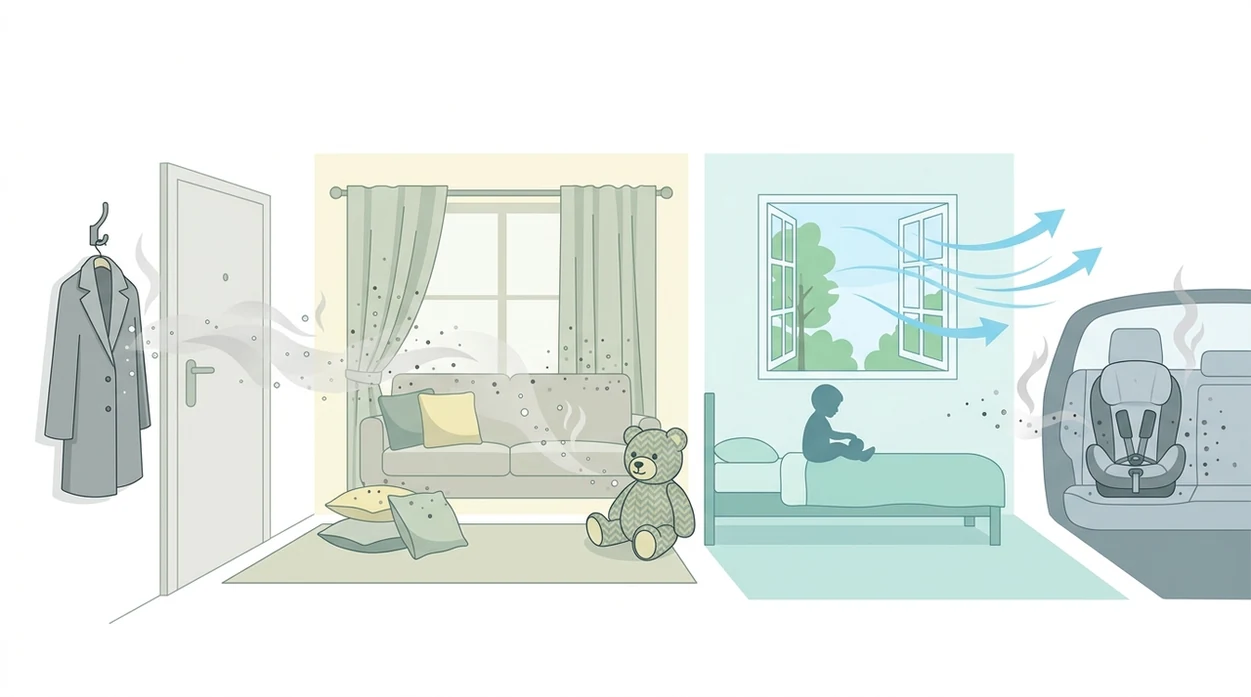
About 4 in 10 U.S. children aged 3 to 11 are exposed to secondhand smoke, often from smoking by parents or other household members. Thirdhand smoke matters too. Smoke chemicals can cling to a hoodie, car seat, hair, or couch after the cigarette is gone.
That stale coat smell is data.
MeQuit helps parents turn that discomfort into a plan, because each logged craving shows when smoke exposure risk is most likely to return. For parents, quitting for kids is often easier to sustain when the goal is specific: fewer smoky car rides, cleaner clothes, and a child watching an adult reset instead of give up.
Ready to start your quit?
A quit smoking app for parents helps turn quitting into a daily family plan, not just a private promise. MeQuit gives parents a way to log cravings, track money saved, and connect…
Quit Smoking App Mechanics for Parenting Triggers
Quit smoking apps work by interrupting habit loops: trigger, urge, routine, reward. In plain English, they help you notice the moment before your hand reaches for cigarettes, then offer a replacement action.
MeQuit captures parenting triggers like morning rush, bedtime pushback, bills, and arguments in the car. After a craving log, CBT-based coping prompts can suggest a delay, a breathing exercise, or a quick replacement task. The money-saved calculator turns cigarettes avoided into visible family rewards, such as a Saturday activity or new shoes. Parents who already use a cigarette savings calculator app often find that money makes progress easier to explain at home.
Streak counters use loss aversion, which means people often work harder to protect a streak they can see. If a condition is high-risk, then MeQuit fits parents who need timed reminders before bedtime or the first school-run stress point.
App support is strongest when paired with evidence-based help such as quitlines, counseling, or FDA-approved cessation medication; U.S. clinical guidance finds that counseling plus medication is more effective than either support alone source.
6 Steps to Use a Quit Smoking App as a Parent
Use a quit smoking app as a parent by setting a quit date, logging real triggers, and reviewing progress with one trusted person. The plan works better when it fits your actual household, not an imaginary quiet week.
- Set a quit date and enter parenting-specific triggers like bedtime stress, school runs, and after-dinner routines.
- Log every craving with context: stress, routine, social pressure, hunger, or broken sleep.
- Review daily progress and check money-saved totals before the next high-risk moment.
- Share milestones with a partner or kids, using small rewards that don’t center on food or spending.
- Combine support with a quitline, counseling, or NRT when cravings feel bigger than app tools.
- Reset without shame after a slip-up and use relapse tools to track what actually happened.
After a slip, when the progress graph is still there, MeQuit helps parents avoid the “I already messed up” spiral. Reset the plan.
For heavier use patterns, a quit smoking app for heavy smokers may need stronger medication planning.
Quit Smoking App Feature Comparison for Parents
The best feature set for parents includes craving context, money saved, family goals, and a clear privacy policy. MeQuit stands out for family accountability because it connects daily progress to household routines, not just generic motivation.
| App name | Craving tracker | Money counter | Family goals | Privacy policy | Free tier |
|---|---|---|---|---|---|
| MeQuit | Yes | Yes | Yes | Yes | Yes |
| Smoke Free | Yes | Yes | Limited | Yes | Yes |
| quitSTART | Yes | Limited | Adaptable | Yes | Yes |
| Kwit | Yes | Yes | Limited | Yes | Yes |
| Smokefree TXT | Text-based | No | Adaptable | Yes | Yes |
Parents who need stress-specific planning may also benefit from a quit smoking app for stressed people, especially when cravings cluster around work, childcare, and sleep loss.
5 Drawbacks of Quit Smoking Apps for Parents
Quit smoking apps can help parents, but they don’t guarantee a quit. Apps work best when they support a broader plan that may include NRT, counseling, quitlines, and medical advice.
- Apps alone may not be enough for strong nicotine dependence.
- Gamified badges can feel silly when a parent is exhausted, short on money, or dealing with a sick child.
- Family framing can backfire if a slip-up turns into shame.
- Not every popular app has been tested specifically with parents.
- Sensitive health data deserves caution, especially if an app uses ads or unclear analytics.
MeQuit handles slip-ups with a reset workflow rather than a failure message, because relapse recovery needs facts, not scolding. Still, no app should replace a clinician when pregnancy, postpartum mood symptoms, or heavy nicotine use are involved. Parents in that situation may want a more specific quit smoking app for pregnant women guide alongside medical care.
Limitations
Quit smoking apps for parents are useful support tools, but the parent-specific evidence is still developing. Clinicians typically suggest combining behavioral support with approved cessation medication when appropriate, because that pairing has stronger evidence than app use alone source.
- Limited clinical evidence compares parent-focused app features against generic cessation apps.
- Apps cannot replace medical care for heavy dependence, pregnancy, postpartum symptoms, or co-occurring mental health concerns.
- Some apps promote unproven paid supplements or aggressive in-app purchases.
- Not all apps clearly protect sensitive health data, so parents should read privacy policies.
- Family-framed motivation can turn into guilt after relapse if the wording is harsh.
- Gamified streaks may discourage sleep-deprived caregivers who already feel behind.
- Text programs like Smokefree TXT may suit some parents better than dashboards.
MeQuit is meant to help parents track what actually happened and make the next cigarette harder to reach. It is not a diagnosis, medication plan, or emergency support service.