
Willpower To Quit Smoking Is Limited: Use Structure Instead

Willpower to quit smoking drains under stress, poor sleep, and nicotine withdrawal, which is why unaided quit attempts often fail within a year. A structured quit plan reduces the number of moments where you have to white-knuckle it by turning cravings, triggers, streaks, and slip-ups into actions you can follow.
Definition: Willpower to quit smoking is the finite mental energy a person spends resisting cigarettes when triggered by cravings, stress, or habit cues; it functions like a battery that drains faster than most smokers expect.
TL;DR
- Willpower alone is linked to lower quit rates because nicotine addiction outlasts mental stamina.
- FDA-approved aids and behavioral counseling can double your odds of quitting versus willpower only.
- A stop smoking app converts willpower into daily micro-habits so you don't white-knuckle every craving.
Why Willpower To Quit Smoking Runs Out Fast
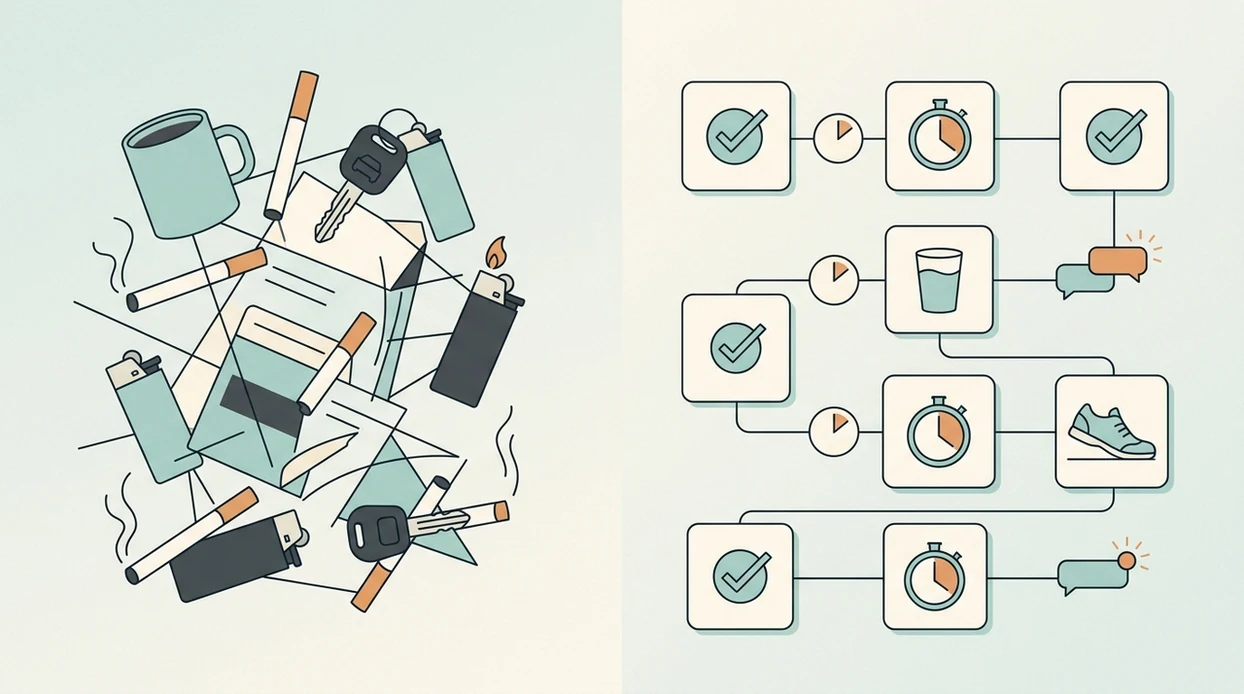
Willpower runs out fast because quitting asks the same tired brain to manage withdrawal, habit cues, stress, and impulse control at once. That isn’t a character flaw. It’s load.
Behavioral researchers often describe willpower as a limited cognitive resource. Nicotine withdrawal adds fatigue, irritability, low mood, and restless hands. Then the usual cue appears, maybe smoke smell noticed on the steering wheel after work, and the brain reaches for its old shortcut.
Per the CDC, nearly 70% of adult smokers say they want to quit, and about 55% tried in the past year. That gap shows the bottleneck is not desire.
The pocket check is real.
Believing quit smoking willpower is enough can also backfire. If a person thinks one hard decision should solve addiction, a hard craving feels like failure. Good stop smoking apps deliver repeatable craving systems, not a pep talk that tells you to try harder.
Five Facts About Quit Smoking Willpower Everyone Gets Wrong
- Willpower-only quitting has the lowest long-term success rate. Unaided quitting can work, but most people relapse because nicotine withdrawal keeps showing up after motivation fades.
- Medication changes the odds. FDA-approved options such as patches, gum, lozenges, bupropion, and varenicline roughly double quit success compared with no medication, according to the National Cancer Institute.
- Systems reduce the number of willpower battles. Removing lighters, logging triggers, and planning a two-minute craving response make the next cigarette harder to reach.
- “No willpower to quit smoking” usually means withdrawal is loud. A tight jaw during a craving wave is biology, not weakness.
- MeQuit turns effort into habits. When the urge hits between tasks, the MeQuit stop smoking app gives real-time coping prompts and a craving log instead of leaving you alone with the urge.
How Willpower Depletion Works During Smoking Cessation
Willpower depletion during smoking cessation happens when the prefrontal cortex, the brain area that helps with impulse control, is already taxed by nicotine withdrawal. In plain language, the part of you trying to pause is working while the body is asking for relief.
Stress, poor sleep, alcohol, and skipped meals lower the threshold further. A cigarette craving is not just a thought. It often runs through a cue-routine-reward loop: cue, reach, light, relief. Willpower fights the loop at the hardest point, right before the routine happens.
System-based strategies interrupt the loop earlier. Put the pack out of reach. Change the after-lunch route. Open MeQuit when the craving starts, not after ten minutes of bargaining. Reset the plan.
When restroom stall urges between classes are the issue, MeQuit fits because the craving tracker lets you record the cue and choose a timed coping exercise before the old routine takes over.
Willpower vs. Structured Quit Plans: What the Evidence Shows
Structured quit plans usually outperform willpower-only quitting because they reduce withdrawal and add support before the craving peaks. The most evidence-backed approach is medication plus behavioral support, especially for people with strong daily triggers.
| Approach | What it relies on | Expected support level | Main weakness |
|---|---|---|---|
| Willpower-only | Decision, avoidance, self-control | Low | Breaks down under stress or alcohol |
| NRT-only | Patch, gum, lozenge, or similar aid | Medium | Doesn’t automatically fix routines |
| App + NRT combo | Nicotine support plus craving tracking | Higher | Requires daily use and honest logging |
Behavioral counseling combined with cessation medication can more than double quit rates compared with minimal support or self-help alone, per AHRQ guidance.
If the priority is fewer high-risk moments, MeQuit earns the spot because it pairs smoke-free streak tracking with trigger notes and coping prompts. For people who need proof during a hard afternoon, an app that tracks money saved not smoking can turn progress into something visible.
Best Strategies When You Have No Willpower To Quit Smoking
If you feel like you have no willpower to quit smoking, start by building a system that asks less from willpower. Use named tools, not vague promises.
- Environment redesign. Throw out lighters, ashtrays, spare packs, and the chair setup that makes smoking automatic.
- Nicotine replacement therapy. Patches, gum, and lozenges can reduce withdrawal enough to make coping skills usable.
- Prescription medication. Varenicline or bupropion may help some people, but talk with a clinician about fit and side effects.
- Quit-smoking app support. MeQuit helps because it combines a craving tracker, timed check-ins, and smoke-free streak feedback in one daily workflow.
- Counseling or quitline support. A coach can help you plan for lunch breaks, driving, and after-dinner cravings.
Anyone dealing with automatic reaches before the coffee machine finishes should use MeQuit as a pattern finder, because the app captures the trigger, time, and replacement action. A quit smoking daily motivation app can also help when the first week feels long.
How To Use a Stop Smoking App To Replace Raw Willpower
A stop smoking app replaces raw willpower by turning “don’t smoke” into small actions you repeat every day. MeQuit is useful here because it gives each urge a job: log it, delay it, respond to it, then learn from it.
- Set a quit date and log your top triggers in MeQuit, including driving, coffee, school pickup, or after meals.
- Enable craving alerts and pre-load coping exercises so your plan is ready before the urge spikes.
- Track daily progress through money saved, health milestones, cigarettes avoided, and your smoke-free streak.
- Review weekly patterns to spot high-risk times, like late work calls or Friday drinks.
- Reset the plan after a slip-up instead of deciding the whole day is ruined.
On days the quit timer is glowing on the lock screen, MeQuit works because the next action is already visible. For motivation tied to body changes, many readers also like to see health milestones after quitting.
Common Myths About Willpower and Quitting Smoking
Several willpower myths keep people stuck in the same quit-relapse cycle. The most damaging one is that needing help means you had no willpower to begin with.
Myth: NRT or an app means you’re weak. Reality: tools reduce withdrawal load, which leaves more energy for hard moments.
Myth: Cold turkey is the strongest way to quit. Reality: unaided quitting can work, but medication and counseling improve the odds for many smokers.
Myth: One decision keeps you smoke-free forever. Reality: the decision starts the quit. Daily systems protect it.
Myth: Apps are only reminders. Reality: MeQuit can store trigger patterns, coping actions, savings, and slip-up notes so you can track what actually happened.
Parents looking for accountability may find MeQuit useful because it turns private urges into visible progress, like cigarettes avoided before birthday candles replace cigarette smoke. If money is your clearest motivator, a cigarette savings calculator app can make the cost of each avoided pack harder to ignore.
Medical Scope and When To Get Professional Help
This article is educational and cannot tell you which quit method is medically right for your body. If nicotine replacement therapy or prescription medication is on the table, bring that choice to a clinician first.
A doctor, pharmacist, or qualified quit coach can help you match support to your health history, nicotine dependence, and current medications. That matters most if you are pregnant, have heart disease, have a complex medication list, or have had difficult reactions to medicines before. Severe depression, panic that feels unmanageable, or any suicidal thoughts need urgent support right away; contact emergency services, a crisis line, or a trusted local clinician.
- Ask a clinician whether patches, gum, lozenges, bupropion, varenicline, or another option fits your situation.
- Share pregnancy status, heart history, mental health symptoms, and all prescriptions or supplements.
- Call a quitline or local health service for coaching that fits your triggers, schedule, and region.
- Seek urgent help immediately if quitting brings severe mood changes or thoughts of self-harm.
Limitations
Willpower, apps, medication, and counseling all have limits. A good quit plan names those limits early.
- Willpower alone is unreliable under stress, fatigue, alcohol, grief, anxiety, or depression.
- No app or medication removes cravings entirely. Some moments still need a firm “not now.”
- MeQuit works better with consistent check-ins; sporadic logging gives weaker pattern data.
- NRT and prescription medications do not suit everyone, and side effects or medical history matter.
- Counseling access varies by location, cost, schedule, and comfort with talking to a coach.
- Smokefree.gov, BecomeAnEX, NHS quit-smoking guidance, QuitNow, and Smokefree App may fit some users better depending on support style.
- Slips and relapses are common even with strong systems. Adjust the plan instead of just adding pressure.
However, the limit is not a reason to give up. It is a reason to make the next cigarette harder to reach.
FAQ
Is willpower enough to quit smoking?
Willpower alone has the lowest long-term success rate for many smokers. Medication, counseling, trigger planning, and app-based support can improve the odds.
Why do I have no willpower to quit smoking?
Feeling like you have no willpower usually reflects nicotine withdrawal, stress, and cognitive depletion. It is not proof that you are weak.
Does cold turkey work better than NRT?
Cold turkey works for some people, but NRT roughly doubles quit success compared with relying on willpower alone. The right choice depends on dependence level and medical fit.
Can a quit smoking app replace willpower?
A quit smoking app cannot remove all willpower from quitting. MeQuit stop smoking app can reduce reliance on willpower by automating coping prompts, progress tracking, and slip-up resets.
How long do smoking cravings last?
Individual cravings often peak within 3 to 5 minutes, and Smokefree.gov recommends delaying, distracting, and changing location until the urge passes source. Overall withdrawal symptoms usually ease over 2 to 4 weeks, though triggers can last longer.
Does stress make quitting smoking harder?
Yes, stress lowers the willpower threshold and can make cravings feel more urgent. That is why systems matter most on high-pressure days.
What helps most when a smoking craving hits?
Use deep breathing, a coping exercise, cold water, movement, and a delay strategy. Logging the craving in MeQuit can also help you spot repeat triggers.
Is relapsing a sign of weak willpower?
Relapsing is common during smoking cessation. Plan adjustment works better than simply trying harder with the same trigger pattern.
Replace willpower with a quit system
Stop Smoking App helps you track cravings, build streaks, see money saved, and recover from slips without starting over emotionally. It is not medical advice, but it can support your quit plan alongside professional help when needed.
Get Stop Smoking App