
Quit Smoking Habit Tracking: Map Your Routines, Urges, and Progress

Quit smoking habit tracking uses a structured system, usually a stop smoking app, to record cravings, skipped cigarettes, triggers, and progress so patterns become easier to change. The strongest trackers connect urge logging with smoke-free streaks, money saved, and coping steps you can use during the next craving wave.
Definition: Quit smoking habit tracking is the practice of systematically logging cigarette cravings, triggers, smoking routines, and smoke-free milestones to identify behavioral patterns and reinforce cessation progress.
TL;DR
- Tracking cravings in real time reveals the specific cues, places, and moods that trigger your smoking routines.
- The cue-routine-reward loop is the core framework. Habit tracking exposes each piece so you can redesign it.
- Consistency matters more than perfection: logging most days and learning from slips beats an all-or-nothing approach.
- Habit tracking works best alongside NRT, counseling, or structured programs, not as a standalone fix.
- Stop Smoking App lets you log urges, view streak data, and connect tracking to actionable coping strategies.
Best Quit Smoking Habit Tracking Methods Ranked
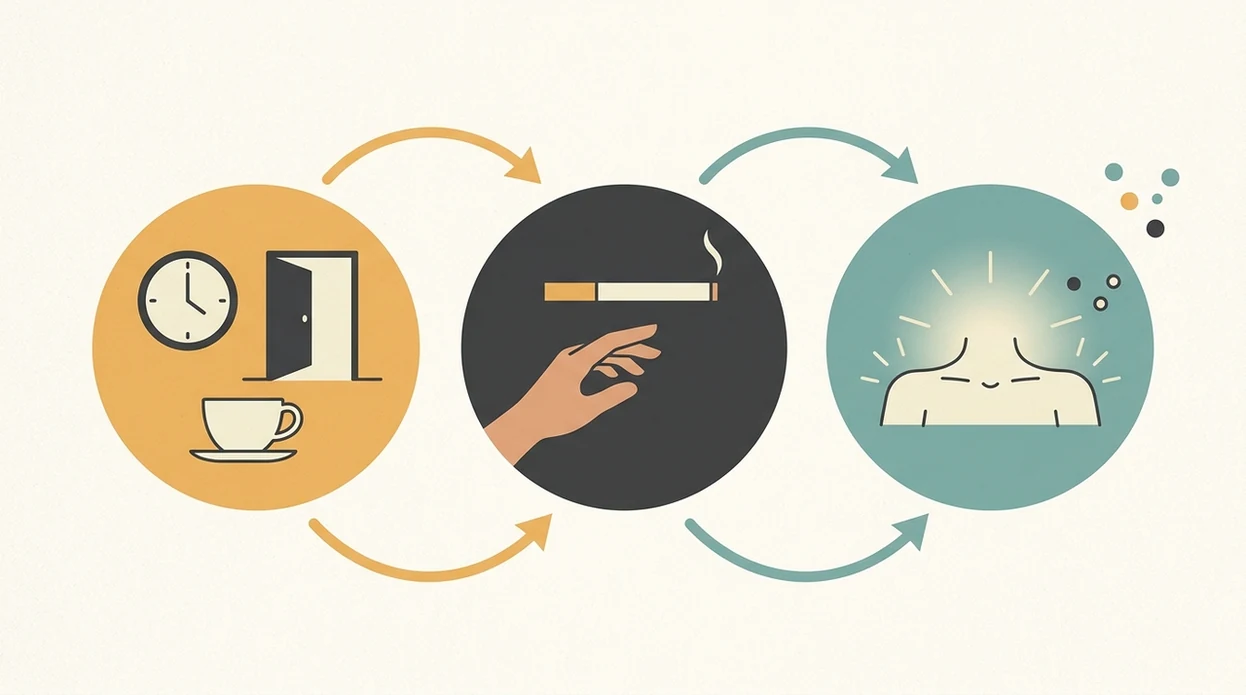
The best quit smoking habit tracking method is the one you can use during a real craving, not the one that looks tidy at night. Good tools capture what happened, when it happened, and what you did instead.
- Dedicated quit-smoking habit tracker: Best fit for people who want cue, routine, and reward tracking in one place. MeQuit is one example because it pairs craving logs with smoke-free streaks, savings, and pattern views.
- Text-message programs: These work for people who need simple prompts and don’t want another dashboard. A lunch-break text can interrupt the automatic cigarette walk.
- Paper habit trackers and journals: Useful for people who think better with a pen. But paper won’t nudge you when winter breath outside the office door becomes the trigger.
- General habit-tracking apps: These can count “no smoking” days, but they usually miss mood, craving intensity, and nicotine-specific coping.
- Calendar streak method: Simple and visual. It works best when paired with a fuller personalized quit smoking plan app.
Smoking Habit Tracking Evaluation Criteria
A quit smoking tracker should be judged by whether it helps you change the next cigarette decision. Per the CDC, only about 7.5% of adult smokers who tried to quit successfully quit in the past year, so tools need to do more than count days source.
We rank methods by five criteria: real-time logging, full habit-loop capture, evidence-based support, ease of daily use, and notification balance. Real-time matters because a craving logged at 2:08 p.m. is more useful than “sometime after lunch.” The full loop matters too: cue, routine, reward.
Tiny details add up.
Good stop smoking apps deliver fast logging, clear feedback, and quit-plan support, not a magic button that removes nicotine dependence. If the priority is learning your repeat triggers, MeQuit fits because the craving log records time, place, urge strength, and what helped you wait it out.
Stop Smoking App: Full Habit Loop Tracking for Daily Routines
MeQuit is the top pick for quit smoking habit tracking when you want to map the whole habit loop, not just mark a smoke-free day. For each craving episode, you can record the cue, the routine you wanted, and the reward your brain was reaching for.
That matters when the empty cigarette pack in the glove box still makes your hand move before you think. MeQuit helps turn that moment into data: trigger, urge level, response, result. Over time, craving data becomes a pattern instead of a blur.
The MeQuit stop smoking app also tracks smoke-free days, money saved, and health milestones. Push reminders can be timed around personal high-risk windows, such as after dinner or before the commute home.
MeQuit is a practical mobile companion, not a clinical tool. For medication choices, the NRT vs cold turkey discussion belongs beside your tracking plan, not inside a streak number.
Text-Message Programs: Automated Smoking Routine Check-Ins
Text-message quit programs are a lighter form of habit tracking because they check in before, during, or after common smoking routines. Randomized trials have found that text-message programs significantly increase biochemically verified quit rates at 6 months compared with minimal support source.
The strength is timing. A prompt that lands before the usual smoke break can make the next cigarette less automatic. The weakness is detail. Most text programs don’t capture the full cue-routine-reward loop.
Less typing. Less depth.
When the trigger moment is fast and predictable, text support can help. MeQuit covers the deeper layer because the urge log keeps the trigger, coping action, and smoke-free result attached to the same event.
Five Facts About Habit Tracking and Smoking Cessation Science
Here are the five facts that matter most about habit tracking smoking routines. Each one points back to the same idea: track what actually happened, then adjust the next plan.
- Tracking makes invisible triggers visible. You may not notice that checkout lines, traffic, and tense messages all create the same urge pattern.
- Immediate logging is more accurate. A dry mouth at the checkout line is easier to record before the memory gets smoothed over.
- Smoking routines follow a loop. Cue, routine, and reward repeat until you interrupt one part on purpose.
- Tracking works better with proven support. The most evidence-backed approach to long-term quitting is behavioral support combined with approved cessation medication when appropriate.
- Lapses are data, not identity. “I already messed up, so I might as well smoke the rest of the day” is a thought to log, not a rule to follow.
After a slip-up, when smoke smell shows up on the steering wheel, MeQuit helps you reset the plan with a logged trigger and a new coping step.
Cue-Routine-Reward Loop: Why Smoking Routines Resist Willpower
The cue-routine-reward loop in smoking is the repeated pattern where a trigger creates an urge, a cigarette becomes the routine, and relief or stimulation becomes the reward. Stress leads to a cigarette, then the brain remembers the dopamine relief.
Willpower struggles because the loop often starts before conscious choice. According to the CDC, about 55.1% of adult smokers tried to quit in a past-year estimate, but most did not stay quit. That is why data matters.
Log the cue. Name the routine. Choose a replacement reward.
For a tight jaw during a craving wave, the substitute might be a mint, a walk to the mailbox, or texting someone before smoking. MeQuit supports this because each entry connects the craving trigger to the response you chose. Many guides from places like Smokefree.gov explain quitting well, but they often skip step-by-step habit-loop logging instructions.
Common Misconceptions About Quit Smoking Habit Tracking
Quit smoking habit tracking helps you see patterns, but it will not automatically make you quit. You still need a quit day, coping strategies, and backup support for high-risk moments.
You also don’t need to be “disciplined” before you start. Tracking is how many people build discipline. A messy first week still counts if you learn that the strongest urge hits after school pickup or during the first drive home.
A stop smoking app alone is not the same as medication or counseling. MeQuit can help you notice smoking routines and practice replacement actions, but nicotine dependence may need medical support too. Clinicians typically suggest combining behavioral support with FDA-approved medications for many people who smoke daily.
Missing a day is not failure. It is a data gap. If you need the first steps laid out, our guide on how to make quit plan with phone keeps the plan simple.
Limitations
Habit tracking has real value, but it cannot do every job in smoking cessation. Counseling plus FDA-approved medications can more than double quit success compared with minimal or no support, according to the U.S. Public Health Service clinical practice guideline source.
- Tracking does not treat nicotine dependence by itself. Heavier smokers often need medication, counseling, or both.
- Self-reported data can be wrong. Delayed logging, skipped cigarettes, and “only recording good days” all distort the pattern.
- Too many notifications can backfire. If every buzz feels like nagging, most users mute it.
- Tracking without a quit date can become passive monitoring. A log needs a plan attached.
- Standalone app research is still emerging. Very high success claims deserve caution.
- Apps such as QuitNow or BecomeAnEX may fit people who want community or structured coaching more than detailed habit-loop records.
On days the quit timer glows on the lock screen but the urge is still loud, a good tracker is useful because it turns that moment into a logged pattern, not a personal verdict. Parents may also need a more family-specific plan, covered in our quit smoking app for parents guide.
FAQ
Does habit tracking replace nicotine patches?
No. Habit tracking is behavioral support, while nicotine patches treat withdrawal by delivering nicotine without smoke.
How often should I log cravings?
Log cravings as soon as possible after they happen. Immediate entries usually capture time, place, mood, and trigger more accurately.
What should a smoking log include?
A smoking log should include time, place, mood, cue, craving intensity, what you did instead, and whether you smoked. These fields show the habit loop.
Can a quit smoking app track vaping?
Yes. MeQuit can support vaping cessation tracking alongside cigarette tracking by logging urges, triggers, streaks, and replacement actions.
Is a paper tracker as effective as an app?
Paper tracking can work if used consistently. It lacks automated streaks, reminders, and pattern visualization.
What if I miss a tracking day?
A missed day is a data gap, not a failure. Resume with the next craving or cigarette and note what interrupted tracking.
How long should I track after quitting?
Many people should track for at least 3 to 6 months. That window covers common relapse triggers and routine changes.
Do free quit smoking tracker apps work?
Free apps can help with basic logging and streaks. They may lack deeper cue-routine-reward tracking and evidence-based support.
Track the habits behind your smoking routine
Stop Smoking App helps you log cravings, identify triggers, follow your smoke-free streak, and recover after slips without shame. Use it as part of a realistic quit plan with added support when needed.
Get Stop Smoking App