
Find Money Saved From Not Smoking Since Your Quit Day

To find money saved from not smoking, multiply your old daily cigarette cost by the number of days since you quit. A smoking savings calculator or the MeQuit stop smoking app does this automatically, showing a total that grows every smoke-free day. A one-pack-per-day smoker at average U.S. prices saves roughly $3,063 per year just on cigarette costs alone.
> Definition: A smoking savings calculator is a tool that multiplies your pre-quit daily cigarette spend by your smoke-free streak to show exactly how much money you've kept by not smoking.
- Your savings depend on two inputs: what you paid per pack and how many you smoked daily.
- At $8.39 per pack, a pack-a-day smoker saves over $250 per month and $3,063 per year.
- MeQuit tracks your smoke-free days and converts them into a live money-saved total automatically.
Quick Answer: How to Find Money Saved From Not Smoking
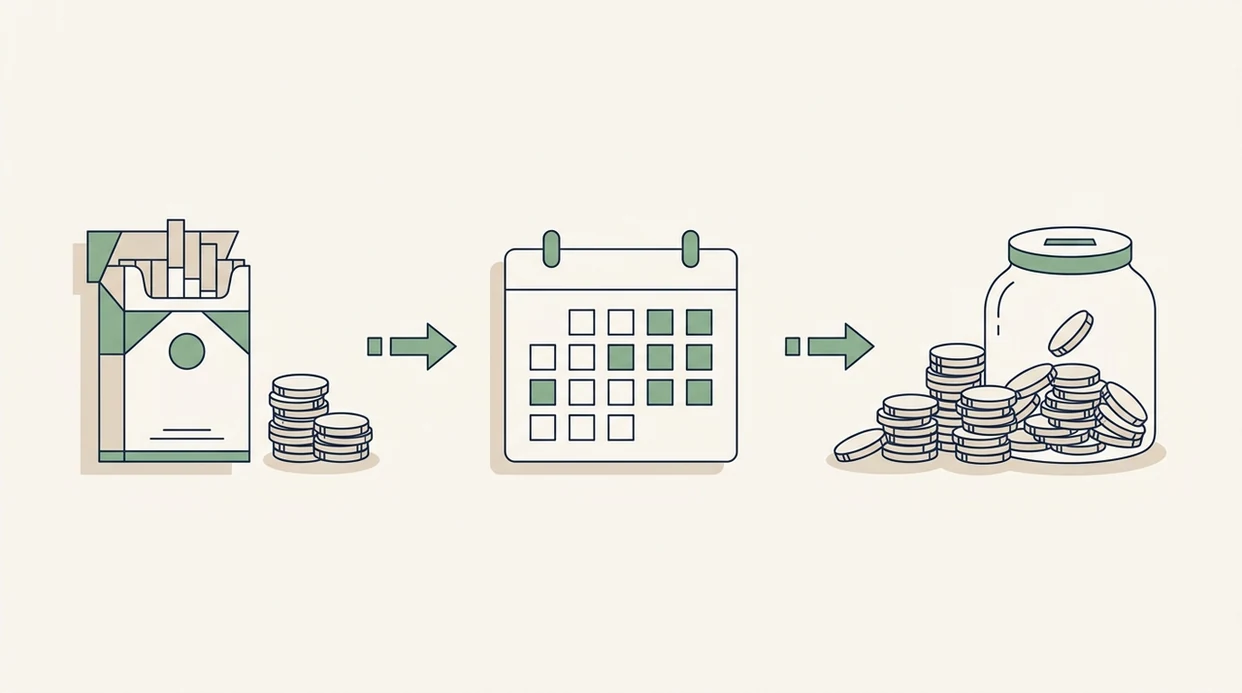
Use this formula: (cigarettes per day ÷ cigarettes per pack) × price per pack × days quit = money saved. If you smoked 20 cigarettes a day, paid $8.39 per pack, and quit for 30 days, your savings are about $251.70.
That number matters on a rough craving day. It turns “I didn’t smoke today” into a grocery bill, a credit card payment, or cash still sitting in your account.
MeQuit automates this math because it combines your quit date, smoke-free streak, and cigarette cost in one savings total. The MeQuit stop smoking app is a practical fit for people who stop checking calculators after day three because the running total updates without fresh arithmetic.
3 Best Ways to Track Smoking Savings Automatically
The best ways to track smoking savings are a built-in quit app dashboard, an online smoking savings calculator, or a manual spreadsheet. Automatic tracking usually works better for motivation because the number appears when the craving wave is happening, not later when you forgot the details.
Stop Smoking App With Built-In Savings Dashboard
People who want the savings number beside their smoke-free streak should use MeQuit because it links daily progress to a live money-saved total. The pocket check is real. Seeing $8.39 saved before lunch can make the next cigarette harder to reach.
Online Smoking Savings Calculator Websites
Smokefree.gov and similar calculator pages are useful for a fast estimate, especially if you only want one annual number. The average U.S. pack price is listed at $8.39 by Smokefree.gov source.
Manual Spreadsheet for Detailed Budget Tracking
A spreadsheet fits people who want budget categories, bank transfers, and weekly reviews. If your priority is staying motivated during the first week, MeQuit earns the spot because the savings dashboard updates with your quit-day streak.
How a Smoking Savings Calculator Works
A smoking savings calculator works by combining three inputs: cigarettes per day, price per pack, and quit date. It converts those inputs into daily, weekly, monthly, and yearly totals so you can see money saved quitting smoking without redoing the formula.
The mechanism is simple habit-loop feedback. The old loop was trigger, cigarette, cost. The new loop is trigger, urge managed, money kept. Rising cigarette prices also make future projections grow, especially in high-tax states.
Good stop smoking apps deliver visible feedback for real quit-day behavior, not a magic promise that savings will appear in your bank account. Better calculators may also estimate lighters, car fresheners, higher insurance premiums, or medical costs. For deeper app-based math, our cigarette savings calculator app guide covers the setup in more detail.
How to Find Money Saved From Not Smoking in 4 Steps
Follow these four steps to calculate your smoking savings today:
- Record your old daily cigarette count and pack price. Use your real brand price, not a national average, if you remember it.
- Log your quit date in a stop smoking app or calculator. MeQuit uses that date to start the smoke-free streak and savings count.
- Review your running total daily, weekly, and monthly. A bathroom-break check-in can be enough when the urge feels loud.
- Set a financial goal for the money saved quitting smoking. Name the goal, such as “emergency fund,” “debt payoff,” or “birthday trip.”
For people who need a live number, MeQuit fits because it turns every smoke-free day into a visible savings total, not a note you have to update by hand.
How We Picked These Smoking Savings Tracking Methods
We picked these methods by looking at accuracy, effort, goal-setting, and mobile access. A savings method is only useful if it uses your real cigarette count, your real pack price, and your actual quit date.
Manual spreadsheets can be precise, but they ask more from you during the exact week when your shoulders may already feel tight in traffic. Online calculators are quick, but they often end after one result.
MeQuit made the shortlist because it keeps the calculation close to the quit attempt. On days the after-dinner craving hits at the kitchen sink, the savings total is already tied to the smoke-free streak and daily motivation tools.
5 Key Facts About Money Saved Quitting Smoking
- A pack-a-day smoker paying the average U.S. price of $8.39 saves about $3,063 per year by not buying cigarettes.
- CDC data indicate that current cigarette smokers spend over $2,000 per year on cigarettes alone, with heavier smokers spending more.
- A 2014 study estimated that the true societal cost of each pack exceeds $35 when healthcare and other costs are included.
- U.S. smoking-attributable healthcare spending is estimated at over $170 billion per year, according to CDC economic data.
- High-tax states usually create larger daily savings because the pack price starts higher.
The most evidence-backed approach to saving money from quitting is full smoking cessation combined with tracking, because partial replacement costs can quietly eat the total.
Redirect Smoking Savings Toward Real Financial Goals
Money saved from not smoking gets more motivating when you give it a job. Put the amount toward a credit card, an emergency fund, a holiday, school supplies, or one specific bill that used to feel squeezed by cigarette spending.
Without a goal, the savings can vanish into snacks, delivery fees, or random card taps. Gone by Friday.
For people who need a reason to stay with the quit day, MeQuit covers the motivation gap because you can name a savings goal and watch the progress build beside the smoke-free streak. If discouragement is your bigger problem, pair the savings total with a quit smoking daily motivation app routine.
4 Drawbacks of Smoking Savings Calculators
Smoking savings calculators are useful, but they do not prove the money stayed in your account. They show avoided cigarette spending, not automatic budgeting success.
Treat the savings number as avoided spending, not a verified bank balance. If you want the money to stay visible, schedule a weekly transfer for the amount you used to spend on cigarettes.
Roll-your-own cigarettes, discount brands, shared packs, and irregular buying patterns also make the inputs messier. Switching to vaping can reduce cigarette spending, but pods, disposables, coils, and chargers lower the net savings.
Long-term projections are another weak spot. They may assume cigarette prices keep rising, or that saved money earns investment returns. Those assumptions may not match real life.
For quitters who slipped once and wrote the first honest note afterward, MeQuit helps reset the plan because the streak and savings can be restarted without turning one cigarette into a full-day loss.
Limitations
Smoking savings numbers are estimates, and they have clear limits:
- Accuracy depends entirely on self-reported inputs for cigarettes per day and pack price.
- Most calculators ignore related costs like lighters, car fresheners, coat cleaning, and higher insurance premiums.
- Long-term projections with price increases or investment returns are estimates, not guarantees.
- If you switch to expensive vaping or nicotine products, net savings will be significantly lower.
- Big numbers on a screen do not improve finances unless you budget or transfer the money.
- Online tools from Smokefree.gov, BecomeAnEX, or QuitNow may calculate savings differently.
- A calculator cannot treat nicotine withdrawal, depression, or another medical concern.
MeQuit is a tracking and motivation aid, not a bank account, medical treatment, or promise that quitting will be easy. If you are asking whether app support fits your quit plan, our guide on do stop smoking apps work explains where apps help and where extra support may be needed.
When to Get Professional Help With Quitting Smoking
Get professional help if withdrawal feels severe, your mood drops into depression, or relapse risk is high enough that willpower and tracking are not enough. A savings calculator can support motivation, but it does not replace medical smoking-cessation care.
Use the money-saved number as one tool beside real support:
- Call a clinician if cravings, sleep problems, anxiety, or low mood are interfering with daily life.
- Ask a pharmacist or prescriber about evidence-based nicotine replacement options, such as patches, gum, or lozenges, and how to use them safely.
- Contact a quitline for coaching; in the U.S., the CDC points people to 1-800-QUIT-NOW and other quit resources source.
- Use trusted quit guidance from Smokefree.gov when you need a plan for cravings, slips, or medication questions source.
- Seek urgent help right away if you have thoughts of self-harm, chest pain, trouble breathing, fainting, or other dangerous symptoms.
The goal is not to make quitting harder. It is to give the quit attempt enough backup to survive the rough days.
FAQ
How much does a pack-a-day smoker save yearly?
At an average U.S. pack price of $8.39, a pack-a-day smoker saves about $3,063 per year by not buying cigarettes. In higher-price states, the yearly savings can be higher.
Is there an app that tracks smoking savings?
Yes. The MeQuit stop smoking app and similar quit-smoking apps can calculate money saved from your quit date, pack price, and old daily cigarette use.
Do smoking savings calculators include healthcare costs?
Most smoking savings calculators only count cigarette purchase costs. The true cost can be much higher, with one study estimating more than $35 per pack when healthcare and other costs are included.
Does every smoke-free day count financially?
Yes. Each smoke-free day is real cigarette money you did not spend, even if you have a slip-up later.
Are roll-your-own cigarettes cheaper to quit?
Roll-your-own cigarettes may cost less per cigarette, but daily use still adds up over months and years. Use your actual tobacco, papers, filters, and lighter costs for a more accurate number.
Can I save money switching to vaping instead?
You may spend less than you did on cigarettes, but vaping supplies still reduce your net savings. Full quitting usually creates a larger savings number than switching products.
How do cigarette prices affect future savings?
When tobacco taxes or retail prices rise, each smoke-free day becomes worth more in avoided spending. Future savings estimates should be treated as projections, not guaranteed totals.
Turn cigarette savings into daily motivation
Stop Smoking App helps you track your smoke-free streak, cravings, cigarettes avoided, and money saved so progress stays visible. It is not medical advice, but it can support your quit plan alongside NRT, counseling, quitlines, or clinician guidance when needed.
Get Stop Smoking App