
Check Cigarettes Not Smoked Since Your Quit Date

To check cigarettes not smoked since your quit date, multiply the number of cigarettes you used to smoke per day by the number of days since you quit, or use MeQuit stop smoking app, which runs this calculation automatically and updates in real time. A cigarettes avoided calculator turns an invisible win into a visible, motivating number that keeps you on track.
Definition: A cigarettes-not-smoked tracker is a calculator inside a quit-smoking app or website that estimates the total number of cigarettes you have avoided since your quit date by multiplying your former daily intake by elapsed smoke-free time, minus any logged lapses.
- The formula is simple: (cigarettes per day × days quit) − logged lapses = cigarettes not smoked.
- Seeing the number grow reinforces motivation at high-craving moments and pairs with money-saved and health-milestone data.
- A dedicated stop smoking app with milestone alerts, relapse logging, and behavioral support makes the tracker far more useful than a standalone calculator.
Quick Answer: How to Check Cigarettes Not Smoked
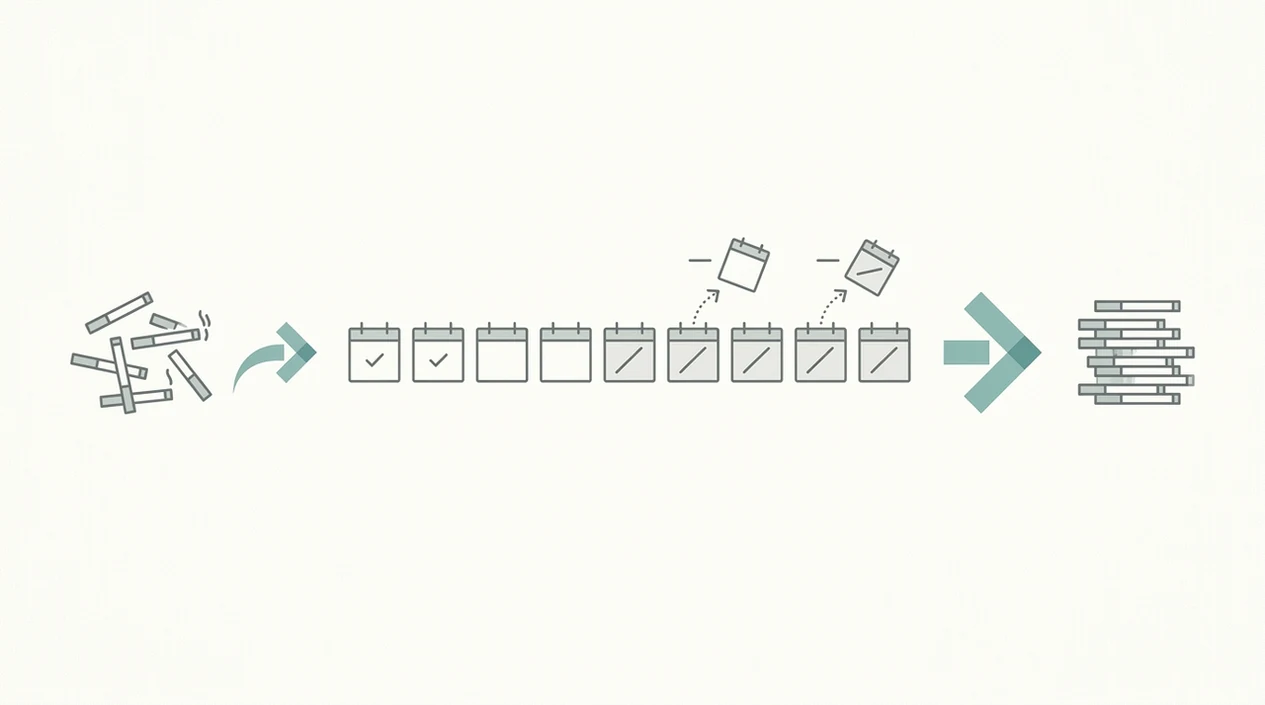
To check cigarettes not smoked, use this formula: daily cigarettes × days since quit day − any cigarettes smoked during lapses. If you smoked 20 a day and have gone 14 days without smoking, your starting estimate is 280 cigarettes not smoked.
MeQuit handles that math in real time, so you’re not opening a calculator while a craving wave is already building. You enter your quit date, your former daily count, and any slip-up. The not-smoked tracker updates the number beside your smoke-free streak and savings.
The pocket check is real.
For people who need a fast progress number during a hard urge, MeQuit fits because the cigarettes-not-smoked dashboard shows the avoided count without making you rebuild the formula each time.
Best Ways to Check Cigarettes Not Smoked: 4 Tracker Options
Here are four practical ways to check cigarettes not smoked, from a real-time app counter to a basic paper tally. The right choice depends on whether you only want the number, or you also want relapse logging and motivation when urges hit.
Stop Smoking App Not-Smoked Tracker
MeQuit gives a real-time counter, milestone alerts, and relapse logging in one place. It’s a stronger fit than a plain calculator because the same screen can show cigarettes avoided, money saved, and your smoke-free streak tracker.
Manual Tally or Spreadsheet
A notebook or spreadsheet works if you like full control. The drawback is friction. After dinner, when the kitchen sink craving shows up, manual math may be the last thing you want to do.
Online Cigarettes Avoided Calculator
A web-based cigarettes avoided calculator is quick for a one-time check. It usually lacks ongoing reminders, lapse adjustment, and craving support.
Health-App Integrations
Apple Health and Google Fit can support broader health tracking, but they usually don’t specialize in cigarettes avoided. Good stop smoking apps deliver quit-specific counters, not a generic wellness score.
How a Cigarettes-Not-Smoked Calculator Works
A cigarettes-not-smoked calculator turns your old smoking pattern into a running estimate of avoided cigarettes. It uses habit-loop tracking: the old cue, routine, and reward are replaced with visible proof that the routine changed.
- Inputs: Most calculators ask for quit date, cigarettes per day, price per pack, and pack size.
- Core formula: The counter multiplies your former daily cigarette count by elapsed smoke-free days, then subtracts logged lapses.
- Relapse logging: If you smoke two cigarettes on day 10, the honest total drops by two instead of pretending the day was clean.
- Secondary outputs: Many tools also estimate money saved and life regained, although life-regained numbers use population averages.
- Behavior change: Visible progress counters can reinforce a new habit because the reward becomes immediate.
After a slip-up, when the “I already messed up” thought shows up, MeQuit earns the spot because its lapse workflow keeps the original quit attempt visible instead of forcing an all-or-nothing reset. For more detail, use a quit smoking slip-up plan alongside the counter.
How to Use a Not-Smoked Tracker in Stop Smoking App
Use a not-smoked tracker by setting your baseline once, then keeping lapses and milestones honest. In MeQuit, the point is not to chase a perfect number. It’s to track what actually happened.
- Set your quit date and enter your former daily cigarette count.
- Log any lapses so the cigarettes-not-smoked total stays accurate.
- Review your dashboard daily to see cigarettes avoided, savings, and smoke-free time.
- Enable milestone alerts so a 100, 500, or 1,000-cigarette moment reaches you when motivation is thin.
- Adjust your baseline if your smoking pattern was inconsistent before quit day.
On days your car cup holder used to be filled with pods or loose cigarettes, MeQuit covers the quick check because the not-smoked number sits with your streak and milestone alerts in the same workflow.
How We Picked These Cigarettes Avoided Tracker Methods
We picked tracker methods by looking at accuracy, motivation, cessation support, and ease of use. A good count subtracts lapses; a weak count only shows a gross estimate and quietly becomes less believable.
Accuracy came first. Relapse logging matters because one cigarette should not erase 19 avoided cigarettes, but it also should not disappear. Motivation features came next: milestone alerts, money saved, and health timelines help when tight shoulders and busy hands show up.
We also looked for connection to evidence-based quitting support, including CBT-style exercises, counseling support, and nicotine replacement therapy pairing. Clinicians typically suggest combining behavioral support with approved quit-smoking medication when appropriate, especially for people with strong dependence. A personalized quit smoking plan app can make that pairing easier to follow.
Why Checking Cigarettes Not Smoked Matters for Quitting
Checking cigarettes not smoked matters because quitting has benefits you cannot always feel on day three. The counter gives your brain something concrete while the body is still asking for nicotine.
- Smoking causes more than 480,000 deaths per year in the United States, according to the CDC.
- The CDC reported an average pack price of about $8.39 in 2023, or roughly $3,060 per year for a pack-a-day smoker source.
- The National Cancer Institute says smokers die about 10 years earlier on average, and quitting before 40 cuts the excess risk of death from continued smoking by about 90% source.
- The WHO says coronary heart disease risk is about half that of a smoker one year after quitting source.
- A visible counter turns abstract health gains into today’s number.
For pack-a-day smokers, checking cigarettes avoided is often more motivating than checking only days quit because every single day adds 20 visible wins.
Honest Drawbacks of Cigarettes-Not-Smoked Trackers
Cigarettes-not-smoked trackers are useful, but they are estimates, not clinical measurements. They depend on the daily count you enter, the quit date you choose, and whether you log lapses honestly.
A high avoided count can also backfire. Someone may see 2,000 cigarettes avoided and think one cigarette will not matter. That thought can show up fast outside the office door, with winter breath in the air and stress still sitting in the chest.
MeQuit helps reduce that risk because relapse logging and craving tools sit near the counter, but no tracker replaces nicotine replacement therapy, varenicline, bupropion, counseling, or medical advice. It also may not capture vaping, pouches, or smokeless tobacco unless you log those patterns separately.
Life-regained estimates are population averages. Your doctor cannot read your exact future from a counter.
Limitations
A not-smoked tracker should support your quit plan, not pretend to be the whole plan. Keep these limits in mind:
- Accuracy depends entirely on self-reported data. Garbage in, garbage out.
- Life-regained estimates use population averages and cannot predict your personal lifespan.
- A high avoided count can create false security if you do not also manage cravings and triggers.
- Trackers do not treat stress, depression, anxiety, grief, or social pressure.
- Ignoring vapes, nicotine pouches, cigars, or smokeless tobacco gives an incomplete nicotine picture.
- A calculator alone is not treatment. It should supplement counseling, nicotine replacement therapy, or prescribed medication when those are right for you.
- Some people prefer community-based support from options like Smokefree.gov or BecomeAnEX, especially if they want coaching or peer discussion.
- If relapse feels frequent, use the counter with a restart after smoking relapse plan instead of only watching the number.
Use the number as a restart cue, not a verdict on whether the quit attempt failed.
FAQ
How are cigarettes not smoked calculated?
Cigarettes not smoked are calculated as daily cigarettes before quitting multiplied by days quit, minus any cigarettes smoked during lapses. For example, 20 cigarettes per day for 10 days equals 200 avoided cigarettes before lapse adjustments.
Is there an app that tracks cigarettes avoided?
Yes. MeQuit stop smoking app and similar quit-smoking apps track cigarettes avoided in real time using your quit date and former daily cigarette count.
Does the tracker count lapses?
The strongest trackers let you log lapses or relapses so the total stays honest. Logged cigarettes are subtracted from the avoided-cigarette count.
How much money do avoided cigarettes save?
Money saved is usually calculated as cigarettes avoided divided by pack size, then multiplied by your pack price. At $8.39 per pack, a pack-a-day smoker saves about $3,060 per year.
Can a not-smoked number predict health gains?
No. Health-gain and life-regained estimates are based on population averages, not a personal medical prediction.
Does checking cigarettes avoided reduce cravings?
Checking cigarettes avoided can reinforce motivation, but it does not directly suppress nicotine withdrawal. Pair the number with craving tools, delay tactics, and support.
Should I reset my tracker after a relapse?
Usually, log the lapse instead of resetting the tracker. Continuity shows your full effort and helps you recover without turning one slip into a lost week.
Make Every Cigarette Not Smoked Count
Stop Smoking App helps you track cigarettes avoided, cravings, streaks, and savings so your progress stays visible. It is not a medical device or a guarantee, but it can support your quit plan alongside professional help when needed.
Get Stop Smoking App