Habit Stacking To Quit Smoking: Build Replacement Behaviors That Stick

Habit stacking to quit smoking means anchoring a new smoke-free action to an existing daily trigger using the formula “After [CURRENT HABIT], I will [NEW HABIT],” so the cigarette no longer owns that moment. A tracker can help make those stacks visible with craving logs, reminders, and a smoke-free streak you can check when your thumb reaches automatically.
Definition: Habit stacking is a behavior-change technique where you attach a new desired action directly after an existing routine, using the established cue to trigger the replacement behavior automatically.
TL;DR
- Use the “After [trigger], I will [replacement]” formula to swap cigarettes for healthier actions at your specific smoking cues.
- Start with tiny, easy stacks, like drinking water or taking 5 breaths, then expand as the new pattern becomes automatic.
- Track every stack and craving in one place so you can spot relapse-prone moments and refine your personal blueprint.
- Habit stacking addresses the behavioral side of addiction. Pair it with NRT or medical support for the biochemical side.
- Only about 4 to 7% of smokers quit unaided; structured behavioral support can raise success rates.
5 Facts About Habit Stacking To Quit Smoking
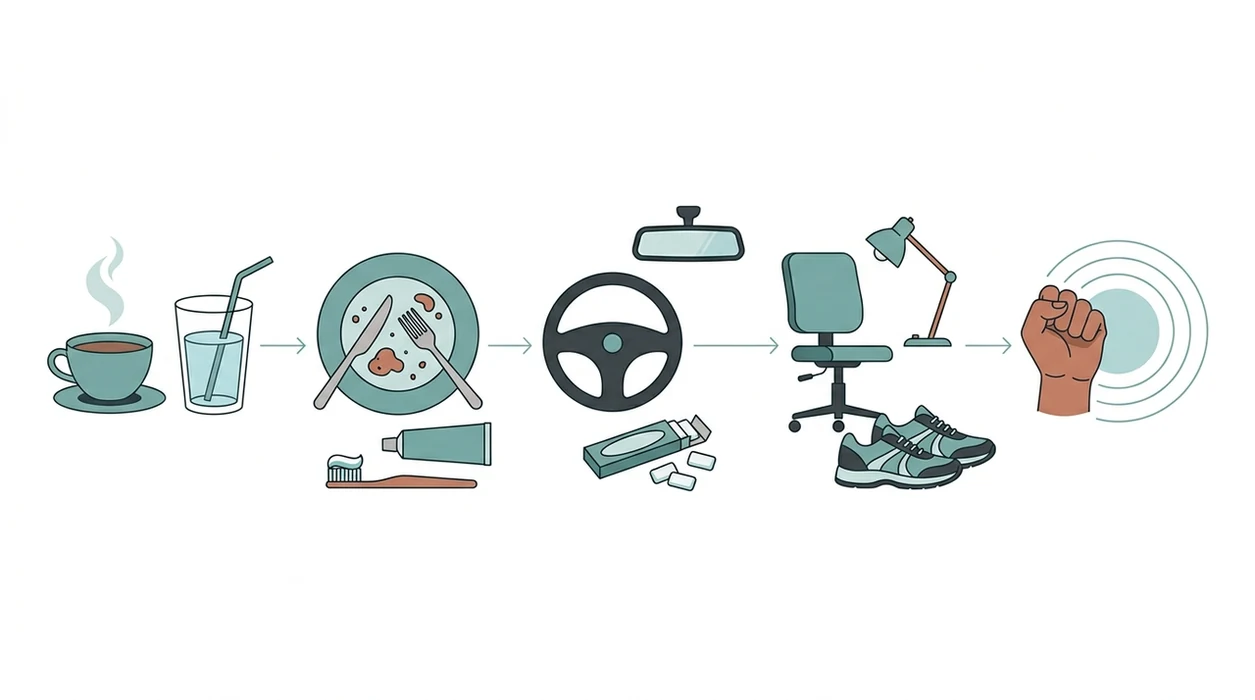
- Habit stacking uses the “After/I will” formula. For smoking, that becomes “After I finish lunch, I will walk to the mailbox,” not “I’ll smoke less today.”
- Specific cues beat vague timing. Post-meal, coffee, stress, car, and work-break triggers are easier to replace than a broad promise like “after work.”
- Tiny stacks are the starting point. One glass of water, five slow breaths, or a two-minute walk is enough for the first week.
- Tracking strengthens the loop. MeQuit lets you log the trigger, urge rating, and replacement action, so the pattern stops living only in your head.
- Habit stacking is not a substitute for medical support. Nicotine withdrawal has a chemical side, and many people need nicotine replacement therapy, medication, counseling, or a quitline too.
After school pickup, when the old routine was lighting up before driving home, MeQuit fits because the reminder can prompt one planned replacement before the car leaves the curb.
How Habit Stacking for Smoking Cessation Works
Habit stacking works by changing the cue-routine-reward loop that keeps smoking automatic. The cue stays, but the routine changes, so “finish dinner” starts pointing to “brush teeth” instead of “go outside for a cigarette.”
Behavioral neuroscience often describes habits as repeated pathways. In plain language, your brain gets faster at whatever you rehearse. Cigarette cues can also trigger dopamine anticipation before you smoke, which is why the urge can arrive before you even decide anything. A replacement action redirects that moment. Not perfectly. Often enough to matter.
Only about 4 to 7% of smokers who quit without evidence-based help stay smoke-free for 6 to 12 months, according to a review indexed by the National Library of Medicine source. A Cochrane review found behavioral support combined with medication can increase quit success by about 70 to 100%.The most evidence-backed approach to quitting usually combines medication or NRT with behavioral support, because it treats both withdrawal and daily triggers.
Best Habit Stacks for Common Smoking Triggers
The best quit smoking habit stacks are short, tied to one real trigger, and easy enough to do while irritated. Good stop smoking apps deliver timing, logging, and feedback, not magic motivation.
Morning & Coffee Trigger Stacks
Morning wake-up stack: “After I turn off my alarm, I will put my feet on the floor and drink water before touching my phone.”
After-coffee stack: “After I finish coffee, I will rinse the mug and step outside without cigarettes.” The first morning reach is sneaky, especially before the coffee machine finishes.
Post-Meal & Work-Break Stacks
Post-meal stack: “After I put my plate in the sink, I will brush my teeth for two minutes.”
Work-break stack: “After I close my laptop for break, I will walk one lap around the building.”
Stress & Commute Stacks
Stress stack: “After I feel my jaw tighten, I will rate the craving and breathe out slowly five times.”
Commute stack: “After I start the car, I will put gum in my mouth before shifting into drive.”
How To Use Habit Stacking To Quit Smoking Step by Step
Use habit stacking by writing one replacement action for one smoking trigger, then testing it for a week. The goal is not to build a new personality by Friday. It’s to make the next cigarette harder to reach.
- List every smoking trigger in a typical day, including coffee, meals, driving, stress, boredom, alcohol, and bedtime.
- Write an After/I will statement for each trigger, such as “After dinner, I will wash my hands and start the dishes.”
- Start with one or two stacks only so the plan survives a hard craving wave.
- Log each stack completion in MeQuit using the craving log, streak tracker, and reminders.
- Review weekly data and adjust stacks that are not sticking, especially triggers with repeated slip-ups.
When the issue is forgetting your plan during a fast craving, MeQuit handles the gap because reminders and urge ratings put the replacement action on the screen before the old routine takes over.
If money is part of your motivation, connect the stack to a visible reward by checking a cigarette savings calculator app after your evening stack.
How We Picked These Quit Smoking Habit Stacks
We picked these stacks by combining public-health evidence, common smoking triggers, and low-friction behavior design. The list favors actions you can do in a parking lot, kitchen, office hallway, or bedroom without special gear.
The CDC reports that millions of U.S. adults still smoke, and most adult smokers say they want to quit. Cochrane evidence supports behavioral help as part of cessation. A BMJ meta-analysis found mobile phone-based cessation interventions increased long-term quit rates, with pooled relative risks around 1.7 source. We also prioritized stacks that fit Atomic Habits principles: obvious cue, tiny action, quick reward.
On days your motivation drops after lunch, MeQuit earns the spot because it records the craving, the stack attempted, and the smoke-free streak in one quick check-in.
Combining Habit Stacking With NRT and Atomic Habits Quit Smoking Strategies
Habit stacking pairs well with nicotine replacement therapy because one handles the routine and the other can reduce withdrawal. A practical stack is: “After a strong craving, I will use my nicotine lozenge and then walk for 2 minutes.”
Clinicians typically suggest combining behavioral support with approved cessation medication when cravings are strong or quit attempts have failed before. A Cochrane review found behavioral support plus pharmacotherapy can raise success rates by about 70 to 100% compared with usual care or minimal support.
MeQuit can sit beside a medical quit plan because it tracks the behavioral pattern: trigger, urge, replacement, and streak. If your doctor recommends patches, gum, or lozenges, the stack can include that step.
For people using NRT, habit stacking is often easier than willpower-only quitting because it gives the body support and gives the hands a job.
When To Get Medical Help While Quitting Smoking
Get medical help while quitting smoking if withdrawal feels unmanageable, your health situation is complicated, or you have smoked heavily for years. Habit stacking can support behavior change, but it does not treat nicotine dependence by itself.
- Talk with a clinician or pharmacist if you are a heavy or long-term smoker, especially before choosing patches, gum, lozenges, prescription medication, or a combined NRT plan.
- Call a quitline or ask about counseling when cravings keep breaking through your stacks. Coaching gives you a real person and a backup plan, not just another promise to “try harder.”
- Seek care promptly if withdrawal includes severe anxiety, depression, thoughts of self-harm, chest pain, or symptoms that feel unsafe.
- Check in before quitting cold turkey if you are pregnant, managing a chronic illness, or taking regular medication, because your quit plan may need closer supervision.
- Use habit stacks as support alongside medical advice, so the cigarette cue has a replacement while the dependence side gets proper treatment.
7 Common Mistakes in Quit Smoking Habit Stacks
Most failed habit stacks are too big, too vague, or never reviewed after a slip-up. Reset the plan.
- Stacking too many habits at once. Three new routines before breakfast is usually too much.
- Choosing vague replacements. “Be healthier” is not a stack. “After lunch, I will chew mint gum” is.
- Expecting cravings to disappear instantly. Rewiring takes repeated practice over weeks.
- Ignoring nicotine withdrawal. Tight shoulders, restless fingers, and a busy mouth may need NRT or medical help.
- Logging only good days. MeQuit works better when the lighter bought with gas station snacks gets recorded too.
- Turning off reminders too early. The cue often returns before the new habit feels natural.
- Treating one slip-up as failure. “I already messed up” is a thought, not an instruction.
If discouragement is the problem, pair stacks with a quit smoking daily motivation app so the reason for quitting shows up before the next urge.
Limitations
Habit stacking is useful, but it is not a stand-alone cure for nicotine addiction. It should be treated as one part of a quit plan, especially during the first week.
- Habit stacking has not been validated in large clinical trials as a stand-alone smoking cessation treatment.
- Heavy or long-term smokers may have withdrawal symptoms that stacks alone cannot manage.
- Poorly defined stacks fail quickly, especially actions like “relax more” or “make better choices.”
- Overly ambitious stacks can create another failure point on an already hard day.
- App-based tracking only helps if you actually log cravings, slip-ups, and completed stacks.
- MeQuit does not prescribe medication, diagnose dependence, or replace a clinician, quitline, or pharmacist.
- Competitor resources like Smokefree.gov and BecomeAnEX may offer coaching or community support that some users prefer.
- Marketing habit stacking as effortless or willpower-free is misleading. Practice still matters.
For many quitters, progress depends more on repeating a small replacement at the real trigger than on designing an impressive morning routine.
FAQ
Does habit stacking replace nicotine patches?
No. Habit stacking targets smoking routines and triggers, while nicotine patches target withdrawal and nicotine dependence.
How long until a stacked habit sticks?
Most habit research suggests a wide range, often about 21 to 66 daysdepending on the action and consistency. Smoking triggers may take longer if the cue is frequent or emotional.
Can I stack multiple habits at once?
Yes, but start with one or two stacks. Add more only after the first stacks feel automatic during normal days and stressful days.
What if habit stacking doesn't stop cravings?
Habit stacking can reduce trigger-driven smoking, but intense cravings may need NRT, medication, counseling, or quitline support. Track what happened and reset the plan.
Is habit stacking from Atomic Habits?
James Clear popularized habit stacking in Atomic Habits. The method also overlaps with BJ Fogg’s Tiny Habits work on small behavior prompts.
Which smoking triggers respond best to stacking?
Post-meal, coffee, and work-break triggers often respond well because they are predictable anchors. Commute and stress triggers can work too if the replacement is very small.
Can an app track my habit stacks?
Yes. The MeQuit stop smoking app can log cravings, stacked behaviors, reminders, and smoke-free streaks so you can see what is working.
Does habit stacking work for vaping too?
Yes. The same cue-routine-reward loop applies to vaping triggers, so the same After/I will method can be used in a stop vaping app.
Build Quit-Smoking Habit Stacks That Stick
Stop Smoking App helps you track cravings, spot triggers, protect streaks, and reinforce the replacement routines that support your quit. Use it as a practical companion alongside evidence-based support when needed.
Get Stop Smoking App