
Benefits of Quitting Smoking: Daily Motivation You Can Track

The benefits of quitting smoking begin within 20 minutes: your heart rate drops, blood pressure moves toward normal, and carbon monoxide starts clearing. Over months and years, those wins compound into lower risks of heart disease, stroke, cancer, better breathing, steadier mood, and money saved. For many people, making those milestones visible is the practical part: the next craving is easier to ride out when progress is specific, recent, and tied to a reason you chose.
> Definition: The benefits of quitting smoking are the measurable health, mental, and financial improvements that begin minutes after your last cigarette and continue accumulating for years after complete cessation.
TL;DR
- Your body starts healing within 20 minutes; heart disease risk halves in one year.
- Quitting by age 40 cuts smoking-related death risk by about 90%.
- Tracking progress with a stop smoking app makes you 2–3× more likely to stay quit.
- Mental health, skin, energy, and finances all improve measurably.
- Full benefits require complete cessation. Cutting down is not enough.
At a Glance: 5 Facts About Quit Smoking Benefits
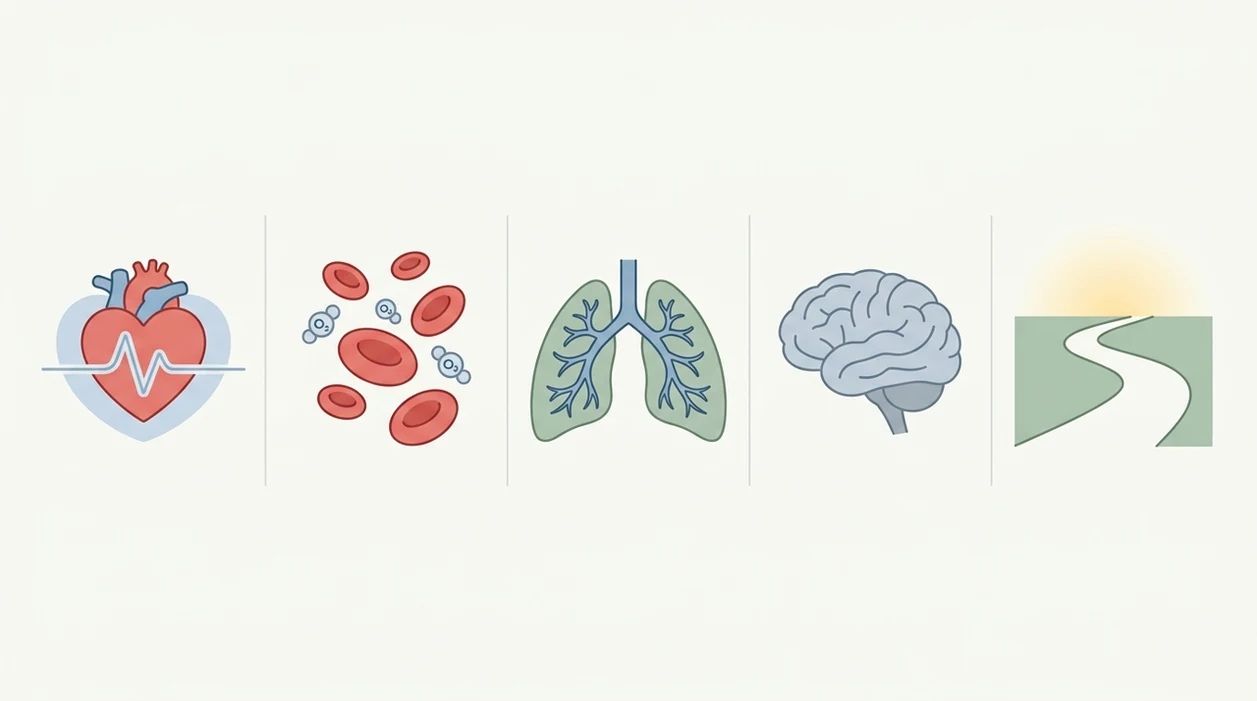
- Your body reacts fast: Within 20 minutes, heart rate and blood pressure drop toward normal, according to the National Cancer Institute.
- Major disease risks fall: Heart disease, stroke, lung disease, and several cancer risks decline over months to years after complete quitting.
- Life expectancy can rise: People who stop smoking may gain up to a decade of life compared with those who continue.
- Mood usually improves: After the first withdrawal stretch, most people report less stress, anxiety, and low mood.
- Tracking helps behavior stick: Behavioral support plus medication can make quitting 2 to 3 times more likely than trying alone.
When the issue is forgetting progress during a rough afternoon, MeQuit fits because the smoke-free streak and health milestones stay visible in one place.
Top 5 Benefits of Quitting Smoking Ranked by Health Impact

The biggest quit smoking benefits are cardiovascular recovery, easier breathing, lower cancer risk, better mental health, and financial savings. These are ranked by health impact first, then daily motivation value.
Cardiovascular and Respiratory Recovery
- Cardiovascular recovery: One year after quitting, excess coronary heart disease risk is about half that of a continuing smoker, per the CDC source. The first walk up stairs can still feel rough, but the trend starts moving your way.
- Respiratory improvement: Coughing and shortness of breath often decrease within 1 to 12 months as lung function improves, according to the American Cancer Society source.
Cancer Risk Reduction Over Time
- Cancer risk reduction: Lung, throat, bladder, and other smoking-related cancer risks drop over years. The longer you stay quit, the more this matters.
Mental Health and Financial Gains
- Mental health gains: Stress often feels worse in week one, then improves as nicotine cycles fade.
- Financial savings: A pack-a-day smoker can redirect thousands of dollars each year.
Quitters who need proof before motivation returns often do well with MeQuit because the cigarette savings calculator turns “not smoking” into a daily dollar amount.
How the Body Heals After Quitting Smoking
How quitting smoking works is partly biology and partly habit learning. Nicotine withdrawal kinetics describe how nicotine leaves the body; habit loops describe the cue, action, and reward pattern that makes the next cigarette feel automatic.
Minutes to Months: Early Physical Recovery
At 20 minutes, heart rate and blood pressure begin dropping. From 24 to 72 hours, carbon monoxide clears, oxygen delivery improves, nerve endings begin recovering, and taste or smell may sharpen. From 1 to 12 months, cilia in the airways recover, lung function improves, and coughing often eases.
The pocket check is real.
A winter breath outside the office door can still trigger the old routine. MeQuit helps because craving logging lets you record the cue, intensity, and outcome before the urge rewrites the story.
Years to Decades: Long-Term Risk Reduction
From 1 to 5 years, coronary heart disease risk drops sharply, and stroke risk can move toward that of someone who never smoked. By 10 to 15 years, lung cancer death risk is far lower than if smoking continued. For a fuller timeline, compare these stages with a quit smoking timeline.
4 Myths About Quit Smoking Benefits and Relapse Risk
Myth 1: “The damage is already done.” False. Health risks drop at any age, even after decades of smoking.
Myth 2: “Quitting always makes stress worse.” False. The first week can be edgy, but mood usually improves after withdrawal settles.
Myth 3: “Cutting down gives the same benefits.” False. Full quit smoking benefits require complete cessation, not fewer cigarettes.
Myth 4: “Vaping is a safe swap.” False. Vaping can sustain nicotine addiction and may keep trigger loops active.
On days the thought is “I already messed up, so I might as well smoke the rest of the day,” MeQuit earns its place because the slip-up reset workflow brings you back to the next smoke-free hour.
Good stop smoking apps deliver tracking, reminders, and behavior support, not a guaranteed cure or a shortcut around withdrawal.
How to Use a Stop Smoking App to Track Quit Smoking Benefits
Use a stop smoking app by turning each benefit into something you can check, log, or review. MeQuit stop smoking app combines milestone tracking, craving logs, savings, and reminders, so the reason to quit is not trapped in a pamphlet.
- Set your quit date and log your last cigarette in MeQuit.
- Review your health dashboard for heart rate, carbon monoxide, lung function, and time-based milestones.
- Track money saved each day, especially if the breakfast screen helps you resist buying another pack.
- Log mood and cravings so patterns connect to smoke-free streaks, not guesswork.
- Enable push notifications for high-risk moments, such as commutes or after meals, with reminders tied to specific benefits.
The most effective combination for staying quit is behavioral support plus evidence-based medication when appropriate, because cravings are both physical and situational. The U.S. Public Health Service guideline reports that combining counseling with cessation medication improves quit rates more than either approach alone source. A smoke-free streak tracker works best when it records what actually happened, not just the final result.
How We Picked These 5 Quit Smoking Benefits
We ranked these benefits using public-health sources from the CDC, National Cancer Institute, American Cancer Society, and peer-reviewed research. We prioritized benefits with measurable outcomes, clear timelines, and direct relevance to daily motivation.
Doctors and tobacco-treatment guidelines often recommend combining counseling or behavioral support with FDA-approved cessation medications for people who need more than willpower. A 2013 New England Journal of Medicine study found quitting by age 40 reduces smoking-related death risk by about 90% compared with continuing source.
We also weighted app-trackability. If a benefit can show up as a milestone, money total, craving pattern, or mood trend, it can help during a hard Tuesday, not only at a doctor visit.
4 Short-Term Drawbacks During Smoking Withdrawal
Withdrawal is temporary, but it can feel loud. The most common drawbacks are irritability, cravings, broken sleep, and trouble concentrating during weeks 1 to 4.
Some people gain a modest amount of weight after quitting. Plan snacks, walks, and water before the hungry stomach right after lunch starts negotiating. Certain lung or cardiovascular damage may never fully reverse after years of heavy smoking, but stopping still reduces future harm.
An app alone is not a magic fix. MeQuit works better when paired with counseling, nicotine replacement therapy, or prescription medication when those fit your situation. Public options like Smokefree.gov and BecomeAnEX can also help, especially if you want coaching or community alongside phone-based tracking.
When to Seek Medical Help While Quitting Smoking
Seek medical help while quitting if symptoms feel dangerous, severe, or outside normal withdrawal. Cravings and irritability are common; chest pain, fainting, severe breathing trouble, or suicidal thoughts need urgent care, not another timer.
- Call emergency services if you have chest pain, severe shortness of breath, fainting, or symptoms that feel like a heart or breathing emergency.
- Contact a clinician promptly if depression becomes intense, panic symptoms feel unmanageable, or you have thoughts of harming yourself.
- Ask about treatment options such as nicotine replacement therapy, varenicline, bupropion, or counseling; these can be matched to your health history and quit pattern.
- Get tailored advice if you are pregnant, medically fragile, managing heart or lung disease, or taking psychiatric medication, because quit plans and medicines may need adjustment.
- Use live support from quitlines, Smokefree.gov, or local tobacco-treatment programs when the evening craving turns into a negotiation.
The goal is not to make quitting more clinical than it needs to be. It is to keep the hard parts supported, especially when withdrawal overlaps with real medical or mental-health risk.
Limitations
The benefits of quitting smoking are real, but they are not instant or identical for every person.
- Reduced heart attack and cancer risk builds gradually over years, not overnight.
- Some people gain weight after quitting, which can partly offset short-term heart benefits if ignored.
- Not everyone’s lungs or heart return to never-smoked levels, especially after decades of heavy smoking.
- A stop smoking app alone does not guarantee success; results are better with counseling, NRT, medication, or social support.
- Withdrawal symptoms can feel intense in the first weeks, but they are not proof that quitting has failed.
- Cutting down may reduce exposure, but it does not deliver the full benefits of quitting smoking.
- Apps cannot diagnose chest pain, severe depression, or breathing problems. Get medical care for urgent symptoms.
When after-dinner dishes are the trigger, MeQuit helps because timed reminders can point back to the exact benefit you chose that morning.
FAQ
How fast does your body heal after quitting?
Your body starts healing within 20 minutes as heart rate and blood pressure drop. Major milestones continue from 24 hours through 15 years, as shown in a quit smoking benefits timeline.
Does quitting smoking improve skin?
Yes, quitting smoking can improve skin by restoring better blood flow and oxygen delivery. Collagen breakdown may slow, so skin can look less dull over time.
What are mental benefits of quitting smoking?
Mental benefits include lower stress, anxiety, and depression after the withdrawal period passes. Early irritability is common and usually temporary.
How much money do you save quitting smoking?
A pack-a-day smoker often saves thousands of dollars per year, depending on local cigarette prices. A savings calculator makes the amount visible day by day.
Is it too late to quit smoking at 50?
No, it is not too late to quit at 50. Health risks drop at any age, though quitting earlier preserves more life expectancy.
Does cutting down have the same benefits?
No, cutting down does not provide the same benefits as complete cessation. Full risk reduction requires stopping cigarettes and tobacco use entirely.
Are withdrawal symptoms a sign quitting won't work?
No, withdrawal symptoms are normal signs that your body is adjusting to less nicotine. Cravings, irritability, and sleep problems usually fade over weeks.
Can an app really help you quit smoking?
Yes, behavioral support tools can help, especially when combined with medication or counseling; supported quit attempts are often 2 to 3 times more successful. Stop Smoking App helps by tracking streaks, cravings, milestones, and money saved.
Do quitting benefits differ for men and women?
The core benefits are shared, including lower heart, stroke, cancer, and lung disease risks. Men and women may also see reproductive and sexual health improvements after quitting.
Track the Benefits of Quitting Smoking
Stop Smoking App (MeQuit) helps you follow your smoke-free streak, cravings, triggers, and money saved so progress is easier to see. Use it as part of a quit plan, and add NRT, counseling, a quitline, or clinician support when needed.
Get Stop Smoking App